Ingrown Toenail
If you have an ingrown toenail that you would like advice on a possible treatment, make an appointment with a clinic that offers a range of treatment options and has high levels of success.
What is an ingrown toenail?
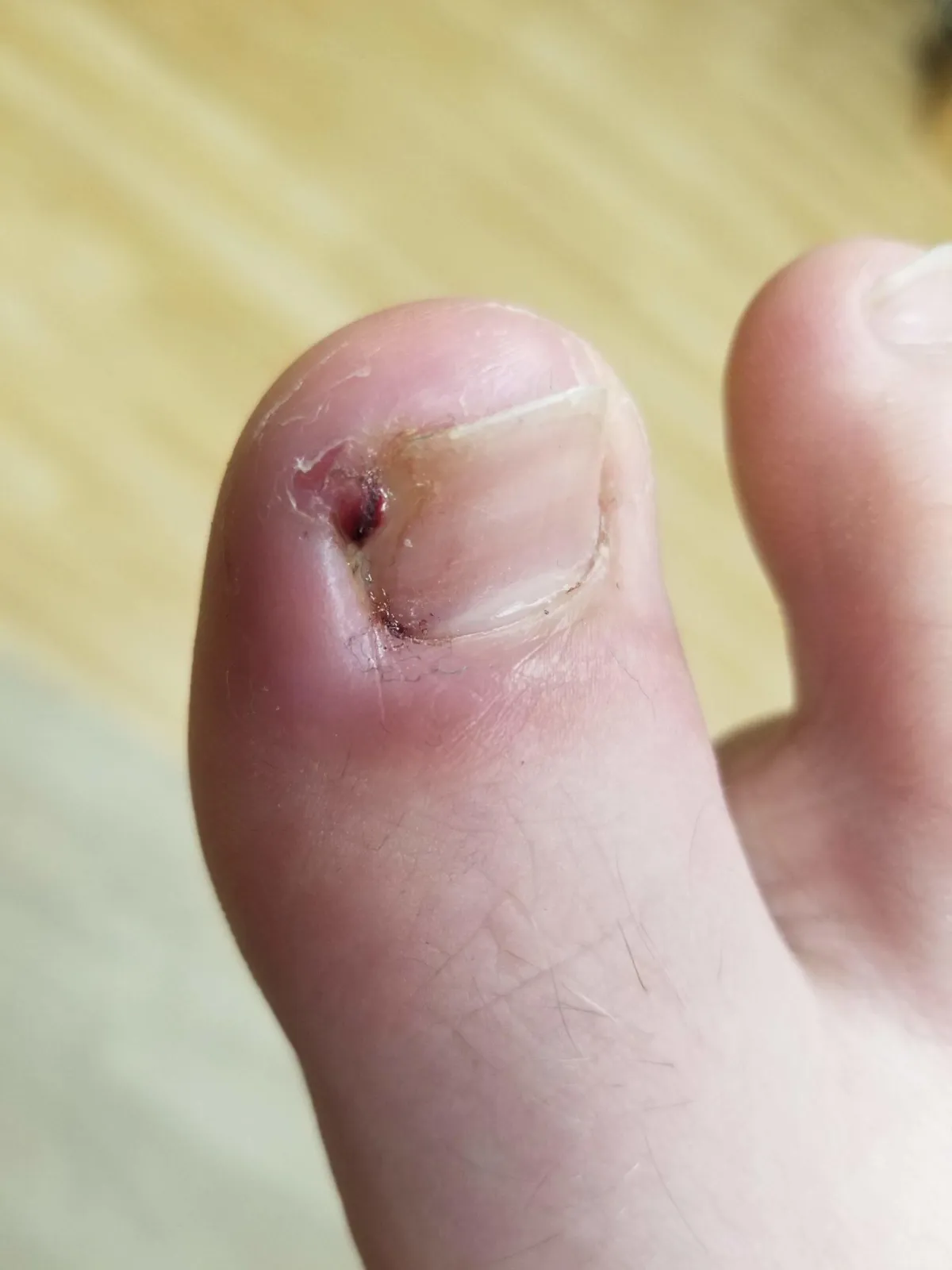
A true ingrown toenail is one where the edge or corner of the nail penetrates the surrounding flesh, thereby causing an open wound which can get infected. This is quite a common occurrence, especially affecting the big toenails.
However involuted or convoluted toenails can cause similar pain to ingrowing toenails, but without the open wound and therefore no infection. These types of toenails have too much curvature across the nail and can be dealt with in the same way as true ingrow toenails.
Pain, redness, swelling, and weepage from the side of a toenail suggests that it is ingrown. This can occur on more than one side or toe at the same time. If left untreated, hypergranulation tissue can form, basically excessive healing flesh. This often requires removal either by chemical cautery or sharp debridement, and a Podiatrist would be best placed to confirm the diagnosis and provide appropriate treatments.
How is an ingrown toenail diagnosed?
Treatments For An Ingrown Toenail In Southam, Warwickshire
There are a range of treatment options available, but once an ingrowing toenail occurs, it is best to get professional advice and treatment.
Simple remedies
Sometimes ingrowing toenails can be alleviated with appropriate nail care (which doesn’t include cutting a ‘V’ in them despite the old wives tale!), correctly fitting footwear, and/or antibiotics if infection develops. Digging an ingrowing toenail out yourself is not the safest option due to the lack of sterility of any tools used, and therefore infection can be introduced or exascerabated. Podiatrists or Chiropodists or Foot Health Practitioners may be able to cut away that part of the nail which is digging into the flesh, either on a one-off basis or by providing regular care to help avoid recurrence. However to achieve the most relief from the problem, we have to somehow alter how the nail grows.
Nail surgery
Generally the preferred option in the UK due to its high rates of success is nail surgery, which can be performed either using a scalpel to cut out the nail matrix (the tissue that generates nail growth) or using chemicals such as phenol or sodium hydroxide to destroy the nail matrix.
Nail surgery is performed following a pre-operative assessment to help ensure that there will be no complications during the procedure and that healing will take place satisfactorily. At my clinic this means a thorough medical history is taken together with indepth assessments for local anaesthetic, nail surgery, and peripheral vasculature (blood supply) involving doppler ultrasonography. The procedure of choice at my clinic is phenolisation of the nail matrix as we have over 99% success rate with this, and it is suitable for involuted nails, convoluted nails, and true ingrown nails. It can even be performed on infected toenails and troublesome fingernails as well.
When performing nail surgery, removing a small part of the nail to resolve the problem is usually the best option. However it is only occasionally necessary to have to lose the whole nail even though this may be the only option offered by others who perform nail surgery. The vast majority of nail surgery
cases only require what we call partial nail avulsion with phenolisation of the nail matrix.
If done carefully by a skilled Podiatrist (Foot Specialist) then you won’t even notice any of the nail is missing, but you will be pain-free most likely for the rest of your life.
Nail bracing
This seems to be more commonly carried out in other European countries as a method of managing ingrowing toenails, possibly due to regulatory restrictions regarding surgery or access to local anaesthetics.
This procedure involves applying a gel or plastic or metal brace across the nail in attempt to straighten out any curvature. It can resolve ingrowing or involuted nails but may not provide a permanent solution without ongoing bracing.
How to prevent ingrown toenails
Firstly, avoiding tight fitting or pointed footwear can help as its stops the toe flesh from being squashed against the nail. Secondly, maintaining good foot hygiene will help reduce the chance of infection occuring if a nail edge should press into the flesh. This involves washing and drying your feet thoroughly each day, wearing clean hosiery, and making sure shoes are completely dry inside before donning them.
Finally it is important to cut toenails properly. You will undoubtedly have heard advice on nail cutting that says you need to cut nails straight across to stop ingrowing toenails. This is not actually the case, especially if your nails are involuted or convoluted. Instead your nail shape should ideally follow the shape of the end of the toe i.e. with a gentle curve. However when cutting your nails you do have to be careful that you don’t leave a shoulder or spike of nail that can press into the surrounding flesh. If you are struggling with your nail care, then regular treatment by a Podiatrist or Chiropodist or Foot Health Practitioner may be required.
REVIEWS
Rated the best podiatrists in Southam — here’s what our patients are saying!
With years of training and experience, we combine our expertise with state-of-the-art equipment to provide the best possible care for all foot and lower limb conditions.
Our highly skilled podiatrists — previously based in London — now proudly serve the Southam community. See why our patients consider us the leading podiatrists in the area by reading their reviews.
Foot Health for the Whole Family at Health First Southam Foot & Gait Clinic
Are your feet being properly looked after? Foot pain, heel pain, even knee pain and back pain can be improved through biomechanical intervention, surgery or other treatments.
In an average lifetime our feet carry us the equivalent of five times around the world. It's not surprising that they need some first aid from time to time. You only get one pair so look after your feet!
Disclaimer
The contents of this website including any details given about conditions and treatments are for information purposes only and must not be used as a guide for self-diagnosis or self-treatment. Health First and Feet First (Southam) Limited do not accept any responsibility if the information held on these pages is used in any other way except for personal enquiry.

Contact Us
Feet First (Southam) Limited
Daventry Street
Southam
Warwickshire
CV47 1PH
Phone: 01926 811272
Email: [email protected]
Company Number: 04642090
Quick Links
Buy Foot Care Products

© 2022 Health First Foot and Gait Clinic | Warwickshire, CV47 1PH
We run on