
Fungal Nail
If you have a fungal toenail that you would like advice on a possible treatment, make an appointment with a clinic that offers a range of treatment options and has high levels of success.
What is a fungal nail?
Fungal infections on your feet are much more common than you might think. Fungus survives in warm, moist and dark environments and can be found anywhere on your body. Unfortunately, your feet naturally provide a perfect place for the fungus to thrive. It’s rare that our feet are not in socks or sweaty shoes, especially for those that lead an active lifestyle.
Your toenails are also particularly susceptible to fungal infections, a lot more so than your armpits or groin. When this happens, it is known as Onychomycosis. As mentioned previously, our feet naturally provide the perfect environment for fungus to grow; this is why we must be diligent in preventing fungus before it becomes an issue. If you feel you may already have a fungal infection, call us for a correct and proper diagnosis and we can begin to discuss treatment options.
How is a fungal nail diagnosed?
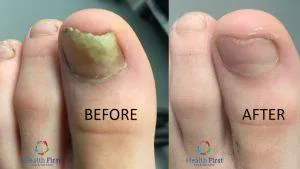
Podiatrists have a great knowledge and understanding of all things foot-related; experienced podiatrists can usually diagnose Onychomycosis just by looking at the nail. The nail will usually show some signs of damage or indication of a fungal problem by becoming crumbly and brittle or turning a yellow or brownish colour. Fungal nails become even more apparent if there are signs of fungal infection on the skin of the foot.
To ensure our diagnosis is correct, we will always run a test just to be sure. This can be done in a couple of different ways:
Microscopy and Culture (M&C)
This method is the one most often used by the NHS; however, in my opinion, it isn’t the best. It can take several weeks to attain results and is often inaccurate or incorrect. These inaccuracies are usually due to the way the nail sample is collected.
Diafactory fungal testing (AKA the FiveMinuteFungus test)
This test operates in a similar manner to a covid 19 lateral flow test. It takes only a few minutes and has an accuracy percentage rate of 95%. This is the type of fungal nail test we use here at our podiatry clinic in Southam because of its accuracy and great results.
Treatments For A Fungal Toenail In Southam, Warwickshire
Treatment options for fungal nails can vary. We use a couple of different methods, depending on the severity of the fungal nail and its location. When treating fungal nails, there are two main aspects that we should consider before we look at other treatment options, these are:
Prevention
Preventing a fungal nail is one of the best ways to treat them. To do this, we need to change the environment in which they survive; this means treating your shoes with anti-fungal spray, ensuring you change your socks regularly and maintaining good personal foot hygiene. Making it difficult for the fungus to survive on your nails or foot will help to prevent reoccurrence.
Toenail Removal
One of the most direct treatment options is removing the nail entirely and destroying the nail matrix; there will be no nail for the fungus to infect. Destroying the nail matrix also stops the nail from growing back, preventing the risk of further infections. The alternative to removing the entire nail is temporary removal; upon doing this, we can apply a fungal nail treatment directly to the nail bed to treat the infection.
Toenail Fenestration
This process involves drilling a number of tiny holes into the nail, allowing a topical anti-fungal treatment to more easily penetrate the nail bed and kill the fungal infection. When drilling holes, you must be careful not to damage the nail bed underneath; if you think this will be the best option for you, you should look out for podiatrists that offer Clearanail or Lacuna methods of treatment.
Toenail Debridement
Toenail debridement involves shaving back the nail, and removing as much of the damaged, crumbly or thickened nail as possible. This increases the efficiency of anti-fungal agents such as amorolfine paint. This filing can be done in a couple of different ways, but it is most often completed using a diamond deb file/foot file or a drill. You should always visit a professional podiatrist to have this completed; trying to do this yourself at home could lead to further injuries.
Photodynamic Surgery
Laser therapy and treatments such as PACT have been found to be a useful method to treat fungal nails in more recent times as it is less invasive, and you can destroy the fungal cells using light. Similar to most of the other treatments above; however, this treatment method takes time. You will likely need multiple sessions for the best chances of success using this treatment method.
Oral Treatments
Terbinafine and itraconazole are two fungal nail treatment methods that are both available in tablet form, meaning they can be delivered straight to the nail matrix through oral ingestion. However, this method of treatment comes with some risks and should always be discussed with your podiatrist or GP before being undertaken. NICE (NHS) guidelines advise that a minimum of 3 nail matrices should have an infection present before oral treatment should be considered.
REVIEWS
Rated the best podiatrists in Southam — here’s what our patients are saying!
With years of training and experience, we combine our expertise with state-of-the-art equipment to provide the best possible care for all foot and lower limb conditions.
Our highly skilled podiatrists — previously based in London — now proudly serve the Southam community. See why our patients consider us the leading podiatrists in the area by reading their reviews.
Foot Health for the Whole Family at Health First Southam Foot & Gait Clinic
Are your feet being properly looked after? Foot pain, heel pain, even knee pain and back pain can be improved through biomechanical intervention, surgery or other treatments.
In an average lifetime our feet carry us the equivalent of five times around the world. It's not surprising that they need some first aid from time to time. You only get one pair so look after your feet!
Disclaimer
The contents of this website including any details given about conditions and treatments are for information purposes only and must not be used as a guide for self-diagnosis or self-treatment. Health First and Feet First (Southam) Limited do not accept any responsibility if the information held on these pages is used in any other way except for personal enquiry.

Contact Us
Feet First (Southam) Limited
Daventry Street
Southam
Warwickshire
CV47 1PH
Phone: 01926 811272
Email: [email protected]
Company Number: 04642090
Quick Links
Buy Foot Care Products

© 2022 Health First Foot and Gait Clinic | Warwickshire, CV47 1PH
We run on